About the Breed
The Pomeranian a royal history
From the sled dogs of Pomerania to Queen Victoria’s palace — small in size, mighty in heart. Everything about the breed, and how to care for it.
Introduction
From sled dogs to palace pets
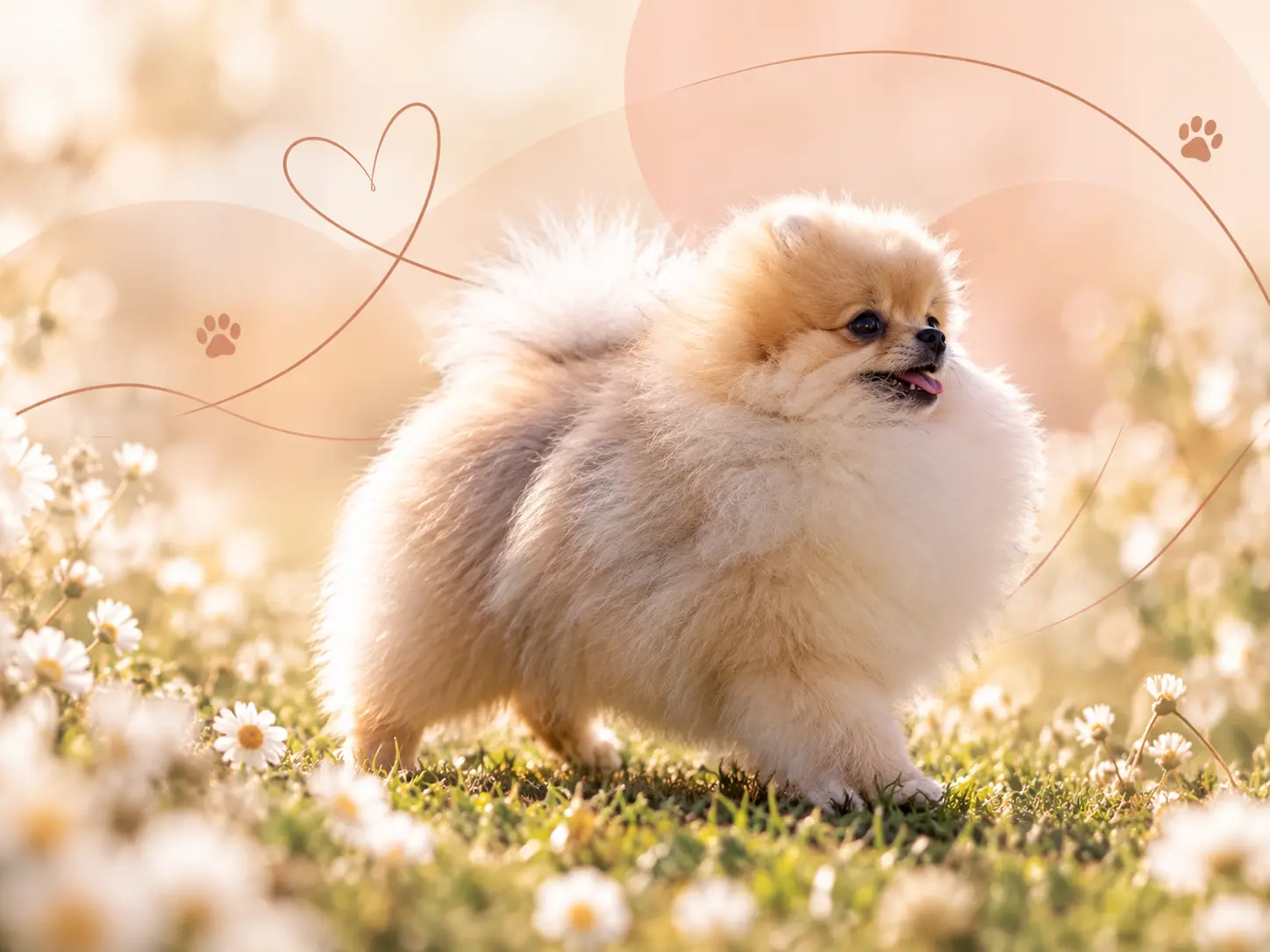
The tiny Pomeranian is the smallest member of the spitz breeds; the Pomeranian has a striking plumed tail that curls forward across its back. Its long thick coat and the attractive mane encircling its face made the Pomeranian a darling of the Victorian period.
Marie Antoinette, the Empress Josephine, Mozart and Emile Zola were proud owners of the little dogs which originated in the Baltic region of Pomerania, once a part of Germany. Gainsborough’s celebrated portrait of Mrs. Robinson depicts an early version of the Pomeranian that is considerably larger than the dog we know today.
The breed did not achieve celebrity until late in the nineteenth century. In 1888, Queen Victoria noticed white Pomeranians during a trip to Florence and soon took a great interest in the breed, founding a kennel and even exhibiting her own dogs. One of these, Gona, won acclaim at several shows. The Queen’s preference for small dogs spurred the selective breeding which resulted in the diminutive size of the modern Pomeranian.
By the turn of the century the Pomeranian had become very fashionable, particularly in Great Britain. One owner, whose dog was renowned for its beauty, refused the princely offer of 500 pounds from an American breeder, causing a sensation even greater than the dog’s splendid appearance.
The Pomeranian’s cleverness, natural gift for entertaining, and adeptness at learning tricks have made it a favourite circus performer. It is an excellent watch-dog with a deep bark that gives the impression of being a much larger dog. No longer is the exclusive breed of royalty, the Pomeranian, just an obedient and affectionate companion.
The Pomeranian’s ancestry can be traced back to the Stone Age dog Canis familiaris; this is a rare example of stability in a breed. Direct forerunners are the sled-dogs of the Middle Ages, some of which migrated to Pomerania, in the Baltic region of what today is Germany, and gave rise to the first Pomeranians. Today’s dog is the product of the nineteenth-century British selection, but the breed is recognized as German. In attempting to further reduce the Pomeranian’s size, British breeders used intensive inbreeding, producing a number of extremely small dogs — some weighing less than three kilograms. They began to mate the smallest animals of their litters, producing offspring of about one kilogram in weight.
Feeding your Pomeranian
Little bellies, frequent meals
Choices: Eukanuba Puppy, Royal Canin (Mini dogs Junior 1–10 kg), Montego Classic for puppies (small bite), Vet’s Choice Puppy or Pedigree Puppy.
I use for wet food: Husky for puppies (chicken & rice) — a tin with a pink label. I use for dry food: Royal Canin Mini Junior.
- 6–12 weeksSoaked in hot water, three times daily (at least!). Make sure the dog does eat.
- ThereafterThree times daily, wet or dry.
- After 12 monthsGood quality adult food.
- AlwaysThere must be fresh, clean water for the dog to drink at all times.
Very important: please ensure that the puppy eats at least 3 times daily, even if it’s only 1 teaspoon at a time. Watch to be sure they actually eat at each meal! More than 3 times per day is even better, but it has to eat frequently. Toy dogs are very small and weigh only a few 100 grams when placed into their new homes. Remember their bellies are small and only hold a small amount at one time, so frequent meals are important. They really do forget to eat, or eat too little when left alone — therefore you have to check on them, otherwise the blood sugar level drops and you end up with a very weak, drowsy puppy!
If this ever happens to you: please give sugar water, syrup or honey immediately. If the puppy does not recover within 5–10 minutes, take it to the vet immediately — this is a life-threatening situation and your puppy can die before your eyes! If the puppy does recover within 5–10 minutes, please give it some food. That is what the puppy needs to keep the blood sugar stable — not medicine, drips and antibiotics. This condition may occur between 8 and 12 weeks (sometimes earlier and sometimes later). Thereafter, the puppy is usually much stronger and eats more!
Please phone me whenever you’re in doubt or want some help. This is a very disturbing situation and one can get very upset, but it is quite easy to control once you know what to do!
You can give the very little puppy, in the evening, about 10 ml of glucose water if you are afraid that the blood sugar level will fall. It is a longer stretch from the meal in the evening to the meal the next morning. It is only for the very little weaker ones, but it will do no harm if you are not sure. The glucose mix is 1 teaspoon glucose on half a cup of water.
More about low blood sugar with puppies: in some respects, bringing your new Pomeranian puppy home is like bringing home a tiny newborn human baby. Most important! Pomeranians, like many toy breeds, may be susceptible to a form of low blood sugar called hypoglycaemia. You probably won’t experience low blood sugar with your particular puppy, but in the event that you do, it is an emergency. Small dogs, especially Pomeranians, have a very small fat reserve around the liver. When they get stressed for some reason (like going to a new home), or if they play too hard (using a lot of energy), or miss a meal, the fat reserve is used up and the body will begin to draw upon the blood sugar for energy.
If this happens to you: immediately put some honey or Golden Syrup on the tongue of the puppy.
Food NOT to feed your Pomeranian
Did you know onions could cause seizures in dogs? Onions contain thiosulfate which causes haemolytic anemia in dogs. Thiosulfate levels are not affected by cooking or processing. Garlic also contains thiosulfate, but in a lesser quantity. Do not feed your dog onions and garlic.
Do not feed your dog chocolates.
Dogs enjoy bones, but they should be given with caution. The bones should be large enough not to break up and splinter, as this could be dangerous. Chicken bones must never be given to dogs. They can too easily be swallowed whole and may become lodged at the entrance to the stomach or the intestines, sometimes with fatal results.
Grooming & Bathing
Keeping the fluff fabulous
You have to brush your dog regularly, at least once a week. Wipe the eyes when weeping — the “weeping eyes” is normal, nothing is wrong! Cut the hair open around the anus to keep the dog clean and hygienic. The hair at the top of the ears and the hair under and around the paws, up till the first joint, should be trimmed for neatness.
Do not shave your Pom! Poms need their coat to insulate them from the heat and cold. There is always a risk that a Pom’s coat will not grow after shaving.
The nails must be clipped every 4–6 weeks. Please be careful not to cut the nails too deep.
When you want to brush your dog, first spray a little bit of the Bay rum mix on the hair and start brushing the hair back against the fall of the hair — with other words, towards the direction of the head. It will stand up and have a fluffy look. Bay rum mix is 30 ml Bay rum on 500 ml water.
After a grooming session, give your dog a healthy treat — and after doing this a few times, I promise you, your dog will be anxious to be groomed! Do the brushing when you don’t have to rush it. The less time and patience you have, the quicker and harder you will do it and scare the dog when it gets too painful. It will not be a treat for him/her.
As a puppy he will have a fluffy coat, which is shed at between three and six months of age. The dog’s permanent coat then starts to grow in, and should be set by the time he is 10 or 12 months of age, although his coat will not reach its full glory until he is about 3 years old.
Bathing
Always brush out your Pomeranian before bathing, and again while blow drying. When done you should easily be able to comb through the entire coat, down to the skin.
During the spring shed, comb out and bathe carefully at least once weekly for 2–3 weeks to prevent hair in the house. Bathing every month is enough (but not necessary).
House Training & Special Tips
Raising a happy Pom
House Training
A puppy must have food and water through the night, as well as an appropriate place to go potty, until he is 6 months old. Poms have tiny stomachs and do not eat much at one time. The puppy cannot and should not hold it all night before this age. In trying to make this happen, you will put the puppy at risk for low blood sugar. You can either leave food and water for him overnight plus a potty pad (alternatively newspaper) for appropriate training, or you can get up with him half way through the night to feed, water and let him go potty.
At three to four months of age, the puppy should go potty:
- Every three to four hours.
- After eating or drinking.
- Just after a nap was taken.
Special Tips
- Because he is so tiny, and quite delicate, a Pom puppy should be handled with care. Once he has outgrown the puppy stage, however, he is quite a hardy little dog who, if kept healthy and at a controlled weight, can live to a ripe old age.
- Children must learn to properly handle a Pomeranian, and only under direct supervision. Small children should be encouraged to sit on the floor to hold a Pomeranian puppy. They should not carry the Pomeranian. You should be sure that your child’s friends also know how to treat the puppy.
- Pomeranians are for gentle loving. When toy breed dogs are teased and tormented by children, they learn to dislike small children. The dog will either run and hide from the child, or it will defend itself. Unfortunately, the dog will end up in trouble if he reacts aggressively.
- Always take care to keep your Pom away from larger dog breeds; hunting dogs naturally think a Pom is the prey.
- Poms need stimulus and an environment that will enhance their intelligence and their physical being. Provide several toys and play games with your Pom.
- Do not leave a collar on a dog that is not supervised. They can catch it on something and hang themselves. Do not pull the lead of a dog; teach him/her to come to you on a loose lead.
Things to Remember
A Pomeranian… at a glance
- Is not a toy. Please handle with care! (Especially small children.)
- Is not human. Please give quality dog food. Not sweets. Chocolates, cake, fatty meals, onions, milk or Pronutro. Table food is not dog food, only a treat. Also keep in mind that they have sensitive digestive systems.
- Has to be brushed regularly, at least once a week. Bathing every month is enough (but not necessary). Wipe the eyes when weeping — the “weeping eyes” is normal, nothing is wrong! Cut the hair open around the anus to keep the dog clean and hygienic.
- Needs to be de-wormed every 3–6 months and inoculated yearly, after the initial 3 vaccinations in the first 3–4 months of its life.
- Should be kept free of ticks — they can cause biliary fever.
- Should be kept free of fleas — they can cause worm infestation and much discomfort!
- Needs clean, fresh water at all times.
- Needs to be loved at all times.
Famous Pom Owners
In good company
As well as Queen Victoria, there are a number of other well-known people said to have owned Poms. These include:
Michelangelo
His Pom sat on a satin cushion watching him paint the Sistine Chapel.
Martin Luther
His Pom, Belferlein, was mentioned on numerous occasions in his written works.
Isaac Newton
His Pom, Diamond, had a habit of chewing up his master’s manuscripts.
Mozart
His Pom was called Pimperl — to whom he dedicated an aria.
Chopin
Was so taken with his girlfriend’s Pom that he composed the Valse des Petits Chiens for the pet.
William Ewart Gladstone
Prime Minister of Great Britain at the time of Queen Victoria, had a black Pom.
Fran Drescher
TV’s The Nanny has included her Pom in some of the episodes of the TV series.